
Comprendre le fonctionnement des organismes vivants, telle est l’ambition du Centre de biologie intégrative (CBI), à Toulouse. Pour atteindre cet objectif, le CBI développe des approches multidisciplinaires, multi-échelles des molécules isolées aux organismes entiers et aux sociétés animales, et utilise de nombreux organismes modèles, des bactéries à l'homme.
https://goo.gl/maps/Tq5uBW1EEkPrg49p7
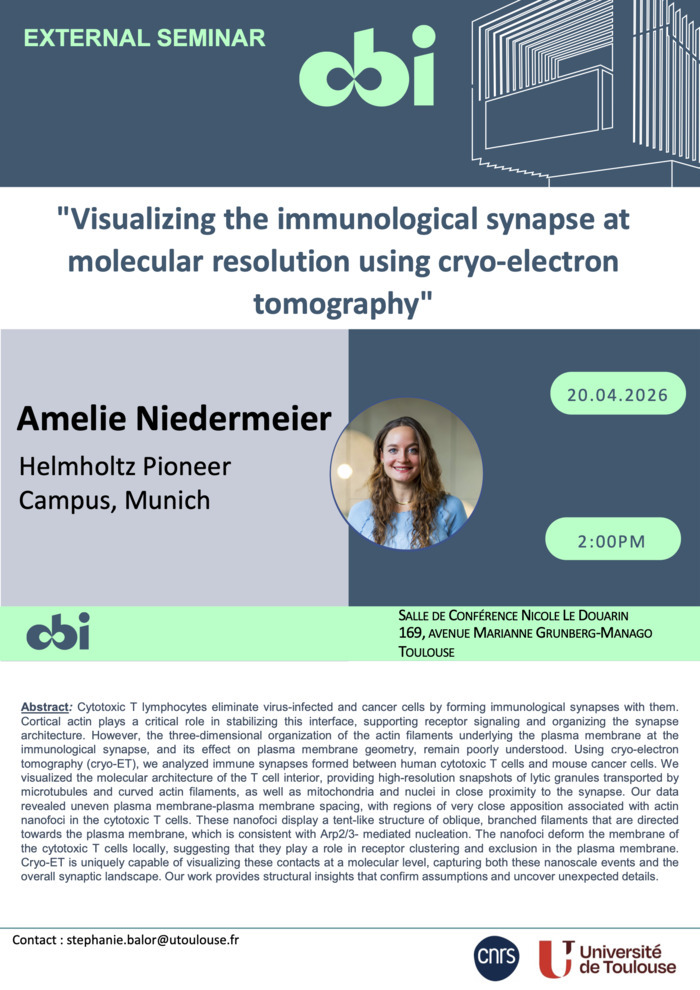
Cytotoxic T lymphocytes eliminate virus-infected and cancer cells by forming immunological synapses with them. Cortical actin plays a critical role in stabilizing this interface, supporting receptor signaling and organizing the synapse architecture. However, the three-dimensional organization of the actin filaments underlying the plasma membrane at the immunological synapse, and its effect on plasma membrane geometry, remain poorly understood. Using cryo-electron tomography (cryo-ET), we analyzed immune synapses formed between human cytotoxic T cells and mouse cancer cells. We visualized the molecular architecture of the T cell interior, providing high-resolution snapshots of lytic granules transported by microtubules and curved actin filaments, as well as mitochondria and nuclei in close proximity to the synapse. Our data revealed uneven plasma membrane-plasma membrane spacing, with regions of very close apposition associated with actin nanofoci in the cytotoxic T cells. These nanofoci display a tent-like structure of oblique, branched filaments that are directed towards the plasma membrane, which is consistent with Arp2/3- mediated nucleation. The nanofoci deform the membrane of the cytotoxic T cells locally, suggesting that they play a role in receptor clustering and exclusion in the plasma membrane. Cryo-ET is uniquely capable of visualizing these contacts at a molecular level, capturing both these nanoscale events and the overall synaptic landscape. Our work provides structural insights that confirm assumptions and uncover unexpected details.
Comprendre le fonctionnement des organismes vivants, telle est l’ambition du Centre de biologie intégrative (CBI), à Toulouse. Pour atteindre cet objectif, le CBI développe des approches multidisciplinaires, multi-échelles des molécules isolées aux organismes entiers et aux sociétés animales, et utilise de nombreux organismes modèles, des bactéries à l'homme.
https://goo.gl/maps/Tq5uBW1EEkPrg49p7