
Comprendre le fonctionnement des organismes vivants, telle est l’ambition du Centre de biologie intégrative (CBI), à Toulouse. Pour atteindre cet objectif, le CBI développe des approches multidisciplinaires, multi-échelles des molécules isolées aux organismes entiers et aux sociétés animales, et utilise de nombreux organismes modèles, des bactéries à l'homme.
https://goo.gl/maps/Tq5uBW1EEkPrg49p7
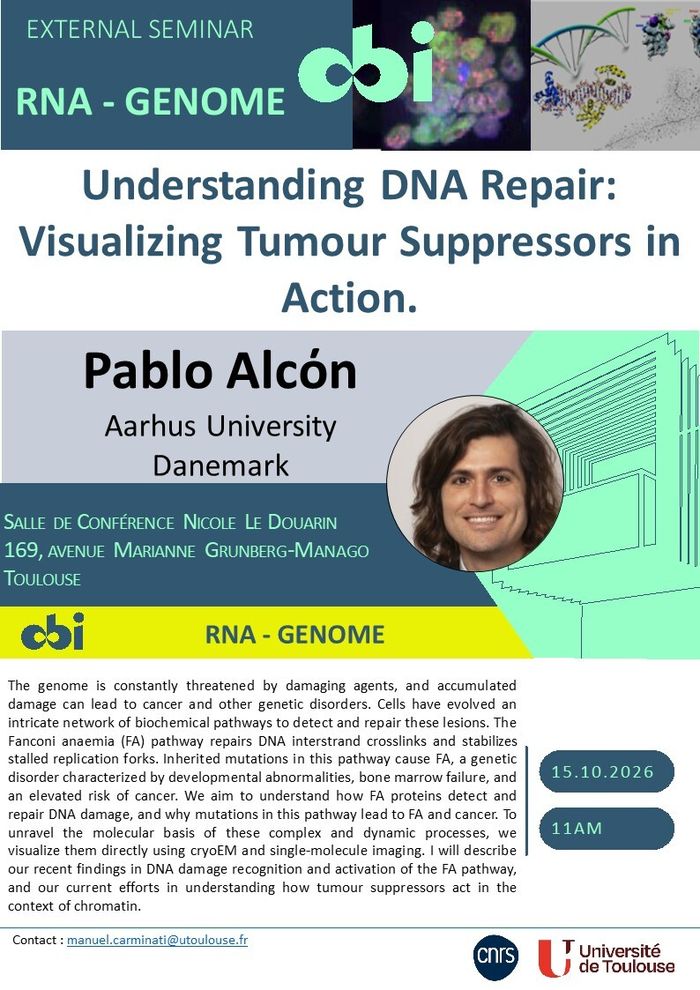
The genome is constantly threatened by damaging agents, and accumulated damage can lead to cancer and other genetic disorders. Cells have evolved an intricate network of biochemical pathways to detect and repair these lesions. The Fanconi anaemia (FA) pathway repairs DNA interstrand crosslinks and stabilizes stalled replication forks. Inherited mutations in this pathway cause FA, a genetic disorder characterized by developmental abnormalities, bone marrow failure, and an elevated risk of cancer. We aim to understand how FA proteins detect and repair DNA damage, and why mutations in this pathway lead to FA and cancer. To unravel the molecular basis of these complex and dynamic processes, we visualize them directly using cryoEM and single-molecule imaging. I will describe our recent findings in DNA damage recognition and activation of the FA pathway, and our current efforts in understanding how tumour suppressors act in the context of chromatin.
Comprendre le fonctionnement des organismes vivants, telle est l’ambition du Centre de biologie intégrative (CBI), à Toulouse. Pour atteindre cet objectif, le CBI développe des approches multidisciplinaires, multi-échelles des molécules isolées aux organismes entiers et aux sociétés animales, et utilise de nombreux organismes modèles, des bactéries à l'homme.
https://goo.gl/maps/Tq5uBW1EEkPrg49p7