
Comprendre le fonctionnement des organismes vivants, telle est l’ambition du Centre de biologie intégrative (CBI), à Toulouse. Pour atteindre cet objectif, le CBI développe des approches multidisciplinaires, multi-échelles des molécules isolées aux organismes entiers et aux sociétés animales, et utilise de nombreux organismes modèles, des bactéries à l'homme.
https://goo.gl/maps/Tq5uBW1EEkPrg49p7

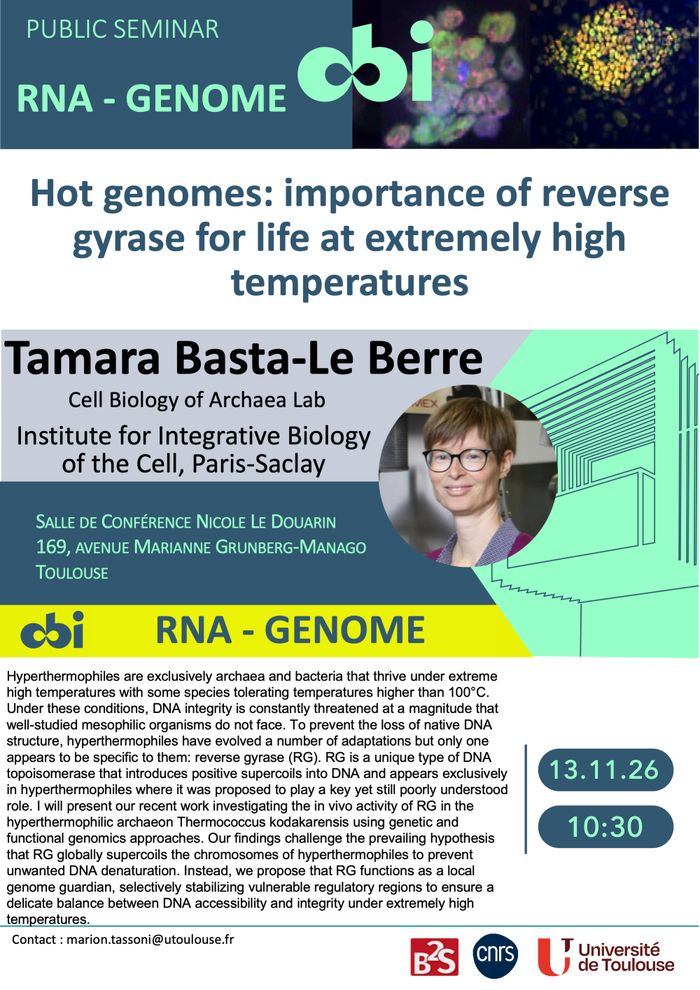
Abstract: Hyperthermophiles are exclusively archaea and bacteria that thrive under extreme high temperatures with some species tolerating temperatures higher than 100°C. Under these conditions, DNA integrity is constantly threatened at a magnitude that well-studied mesophilic organisms do not face. To prevent the loss of native DNA structure, hyperthermophiles have evolved a number of adaptations but only one appears to be specific to them: reverse gyrase (RG). RG is a unique type of DNA topoisomerase that introduces positive supercoils into DNA and appears exclusively in hyperthermophiles where it was proposed to play a key yet still poorly understood role.
I will present our recent work investigating the in vivo activity of RG in the hyperthermophilic archaeon Thermococcus kodakarensis using genetic and functional genomics approaches. Our findings challenge the prevailing hypothesis that RG globally supercoils the chromosomes of hyperthermophiles to prevent unwanted DNA denaturation. Instead, we propose that RG functions as a local genome guardian, selectively stabilizing vulnerable regulatory regions to ensure a delicate balance between DNA accessibility and integrity under extremely high temperatures.
Comprendre le fonctionnement des organismes vivants, telle est l’ambition du Centre de biologie intégrative (CBI), à Toulouse. Pour atteindre cet objectif, le CBI développe des approches multidisciplinaires, multi-échelles des molécules isolées aux organismes entiers et aux sociétés animales, et utilise de nombreux organismes modèles, des bactéries à l'homme.
https://goo.gl/maps/Tq5uBW1EEkPrg49p7